
Author: Melanie Sadek
President & CEO, Valley Humane Society
California is lucky to have so many people who passionately advocate for animals. But passion alone isn’t enough to protect animals in a high-pressure system with no centralized oversight.
Recent horrific cases involving overcrowded rescues and a shelter bring to light the urgent need to better manage all parties concerned with animal welfare in this state.
On Monday, August 24, I moderated a press conference at the State Capitol bringing together animal welfare organizations, law enforcement and advocates from across California to call for the creation of a Bureau of Companion Animal Welfare.
This Bureau would serve as the foundation on which to build trust around and within the animal welfare industry and ensure consistency and accountability for animals, organizations, and the public.

The pressure to save every animal
For years, our industry has been trying to reconcile two difficult realities: an overwhelming number of animals entering the sheltering system and a community that understandably does not want animals euthanized.
National messaging has reinforced the idea that every animal deserves a positive outcome. It’s an easy goal to support.
Of course we want to save them all.
We would love to ensure every puppy is properly socialized and grows into a well-adjusted adult. We would love for our housing industry to recognize animals as family rather than additional liabilities or sources of revenue. We would love to spay and neuter every dog and cat to help end overpopulation.
There is nothing wrong with setting big goals.
But there can be unintended consequences when the expectation to save every animal becomes more important than asking whether we have the capacity and resources to give that animal the life we are promising. In our fight to save animals, we may actually be hurting their chances of finding a home.
Shelters face enormous pressure to save every animal in their care, often without the resources, volunteers, and adopters necessary to do so. Government shelters are housing dogs in spaces never intended to be kennels. Animal welfare employees are threatened and accused of not caring about animals because they make difficult euthanasia decisions.
Yet CalAnimals recently surveyed Californians and found that one of the top reasons people don’t adopt is because they are afraid to go to a shelter where animals are euthanized.
Rescues and shelters are inundated with pleas for help. Saying no is incredibly difficult when saying yes may mean saving a life. But organizations that continue saying yes can end up with more animals than they can responsibly care for.
Animal control agencies are investigating cases like these throughout California. None of this is healthy for our industry, and it isn’t helping animals.
Miranda’s Rescue forces us to confront the system
The allegations involving Miranda’s Rescue in Humboldt County are an extreme and horrifying example of what can happen when an organization entrusted with animals operates without meaningful oversight.
According to public information from the Humboldt County Sheriff’s Office, investigators recovered canine remains, skulls, bones, and more than 600 dog collars from the property. Preliminary examinations found evidence that many of the recovered dogs died from gunshot wounds, and hundreds of additional dogs transferred to the rescue remain unaccounted for. The investigation is ongoing.
So much of the money given to Miranda’s Rescue came from people who believed they were helping keep dogs alive. Public shelters, rescue groups, and advocates raised money to give what they believed would be a positive future to hundreds of dogs. I speak from experience. In 2023, Valley Humane transferred a dog who was struggling in our living spaces to Miranda’s Rescue. We had done our research and heard only positive stories. Now we must face the heartbreaking possibility that he, too, may be among the dogs who died.
The lack of oversight is hurting shelters and rescues
Government animal control agencies are the ones called in when well-intentioned people become overwhelmed, and situations turn into hoarding cases. Those experiences understandably make shelters cautious about where they transfer animals. They respond by creating restrictions governing which rescues can pull animals and what those rescues must do to remain in good standing. But those requirements can also make it harder for responsible rescues to take animals out of overcrowded shelters.
Meanwhile, when an animal leaves a shelter for a rescue, the responsibility for that animal doesn’t disappear. The receiving organization becomes responsible for that animal and for complying with the laws that apply to its care and placement.
California already has numerous laws governing the care, sale, transfer, sheltering, rescue, and boarding of companion animals. The problem is that those laws are fragmented across statutes, agencies, and local jurisdictions, with no single state entity responsible for coordinated, statewide implementation.
For the past three years, Valley Humane has been part of a larger effort to ask what a better system could look like. Through my role as Chair of the California Animal Welfare Association’s Legislative Committee, I participated in the committee that researched oversight models in other states and helped shape the proposal for a California Bureau of Companion Animal Welfare.
It was important to bring the perspective of organizations actually doing this work to that discussion. We don’t need a system that makes lifesaving harder. We need one that creates trust, accountability, and consistency while supporting organizations doing this work responsibly.
Trust must be at the forefront of animal welfare
Across our state, roughly 300 public and private animal shelters and thousands of rescue organizations work every day to save animals. Both play an important role in lifesaving. At Valley Humane Society, we know firsthand that we cannot do this work alone. Shelters need rescues. We all need fosters, adopters, volunteers, veterinarians, and donors.
And we all want the same things: to save animals, to see shelters and rescues working together, to give donors confidence that their generosity is making a difference, and to ensure the public can trust the organizations they turn to for help.
Ultimately, our communities fund this work. Government shelters operate with local tax dollars, while private shelters and rescues depend heavily on charitable donations.
Our donors should be able to know that the organizations they support are doing what they say they are doing. Shelters should have confidence when they transfer an animal to a rescue. Rescues operating responsibly should be able to work with shelters more easily.
And the public should have somewhere to turn when something doesn’t seem right.
That is why Valley Humane supports the creation of a California Bureau of Companion Animal Welfare.
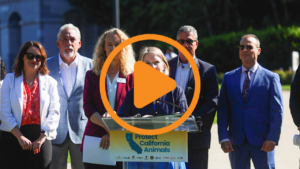
See the press conference in our state capitol.
A solution that supports everyone doing this work responsibly
The proposed Bureau would establish statewide registration and licensing for shelters, rescues, sanctuaries, breeders, and boarding facilities. It would conduct inspections, receive and investigate complaints, collect statewide data, and coordinate with local animal control, public health departments, and other agencies.
Importantly, the Bureau would not replace local animal control or law enforcement. The legislation specifically preserves existing state and local authority.
The Bureau would establish clear expectations. It would provide information about what is happening to animals across California. And it could identify problems earlier, before hundreds of animals are suffering and law enforcement is left responding to a catastrophe.
Building a stronger system together
California’s animal welfare community is filled with people who care deeply about animals. That passion is one of our greatest strengths. But passion alone cannot be the system that protects them.
I am proud that Valley Humane has had a role in moving this conversation forward. We believe our work doesn’t stop with the animals who come through our doors. We also have an opportunity to help strengthen the larger system animals throughout California depend on.
We have been laying the foundation for this work for three years. It shouldn’t take tragedies like Miranda’s Rescue or Villa Chardonnay to convince us that we can be better.
A Bureau of Companion Animal Welfare gives us an opportunity to build trust into the system and strengthen the work already being done across California.
Our passion for saving animals has got us this far. Now we have an opportunity to build a stronger system around it.