- This event has passed.
National Check the Chip Day
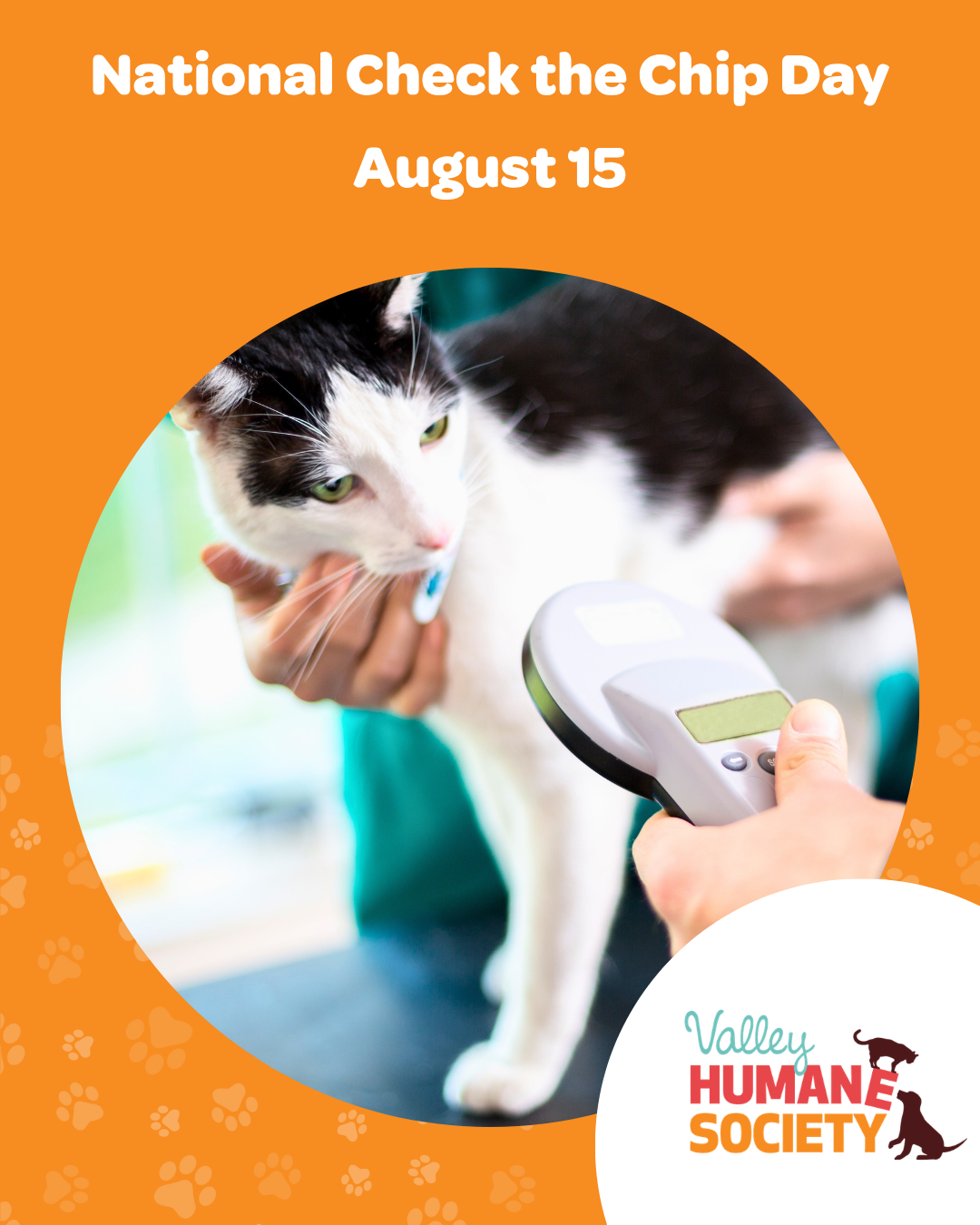
National Check the Chip Day: Give Your Pet Their Best Shot at Coming Home
Every August 15, National Check the Chip Day reminds pet families of one small task that carries a big payoff: making sure your pet’s microchip is registered and up to date. A microchip is one of the most reliable ways to reunite a lost pet with their people, but it can only do its job when the contact information linked to it is current.
This year, Valley Humane Society is inviting all pet guardians, including our alumni and adopters, to take a few minutes anytime during the month of August to double-check their pet’s chip.Come on by our adoption center Tuesdays-Saturdays from 10am-4pm at 3670 Nevada St in Pleasanton for a free scan. It is a simple habit that can make all the difference on the day you hope never comes. As a thank-you for coming in, we are handing out free QR code ID tags while supplies last.
What Is Check the Chip Day?
National Check the Chip Day is an annual observance on August 15, created to encourage pet owners to confirm two things: that their pet is microchipped, and that the microchip is registered with accurate, up-to-date contact information. Getting your pet chipped is only the first step. The chip has to be registered and kept current to actually bring your pet home.
Your Check the Chip To-Do List for August
Set aside a few minutes this month and walk through these steps for each pet in your home.
First, confirm your pet is microchipped. If you adopted from Valley Humane Society, your pet came home already chipped, and we can help you find the microchip number. If you are not sure whether your pet has a chip, most veterinary clinics can scan for one during a routine visit, or visit Valley Humane and we can scan your pet for free as well.
Second, find your pet’s microchip number and make sure the chip is registered with the chip manufacturer. The registry the manufacturer maintains is the one animal shelters and veterinarians actually search, so that is the one that counts.
Third, check that every detail on file is correct, especially your phone number, email, and home address. If anything has changed since last year, update it right away.
Finally, ask your veterinarian to scan your pet’s microchip at your pet’s annual wellness exam to confirm it is still working and can be read.
How to Update Your Pet’s Microchip Registration
To update your registration, you will need your pet’s microchip number. If you have not created an account with the chip’s manufacturer yet, you will set one up as part of the process. From there, review every field and correct anything that is outdated.
Not sure which registry your pet’s chip belongs to? The American Animal Hospital Association (AAHA) offers a free universal microchip lookup tool that identifies the right registry for you. Your veterinarian or shelter/rescue where you adopted your pet from can also help you track it down.
Need a Microchip? We Can Help
If your pet is not chipped yet, or if you have added a new furry family member, Valley Humane Society makes it easy to take care of it. You can book a microchip appointment through our low-cost vaccine clinic.
Book a microchip appointment at our vaccine clinic
Microchipping is quick and low-stress. The chip is placed just under the skin between the shoulder blades using a preloaded syringe, and it feels about the same as a routine vaccine. No surgery or anesthesia required. Once it is in, remember to register it right away in your name.
Pick Up a Free QR Code ID Tag After Your Pet’s Scan
All month long, we are offering free QR code ID tags to pet guardians and Valley Humane Society alumni who come in for a microchip scan, while supplies last. A microchip is permanent, tamper-proof identification, and a visible ID tag means anyone who finds your pet can reach you right away without a scanner. Together they give your pet the best possible chance of getting home fast.
Microchip FAQ
What is a pet microchip? A microchip is a tiny electronic device about the size of a grain of rice, enclosed in a smooth glass cylinder. It has no battery. When a scanner passes over it, the scanner’s radio waves activate the chip, which transmits its unique identification number.
Does a microchip track my pet’s location? No. A microchip is not a GPS device and cannot track your pet. It simply stores a unique ID number that a scanner can read. That number links to your contact information in the registry.
Does a microchip replace ID tags? No. Microchips and collar tags work best as a team. A collar tag lets anyone who finds your pet contact you immediately, while the microchip is permanent backup identification in case the collar is lost or removed. Keep your pet’s rabies tag on the collar too.
Is microchipping safe? Yes. Microchips have an excellent safety record, and complications are uncommon. The chip is designed to last your pet’s lifetime with no need for replacement.
Where can I get my pet microchipped? Book an appointment at our vaccine clinic. Chips should always be implanted by, or under the supervision of, a veterinarian/licensed vet tech to make sure they are placed correctly.
I just adopted a pet. How do I find their microchip number? If you adopted from Valley Humane Society, reach out and we can help you locate the number so you can register the chip in your name. Any veterinary clinic can also scan your pet at a checkup.
Take a Few Minutes This Month
A current microchip registration is one of the kindest, simplest things you can do for the pet who counts on you. This August, check the chip, update your info, and grab a free QR ID tag from Valley Humane Society. Your future self, and your pet, will thank you.